Check out the list of Cities in the United States that have the Dirtiest and who has the cleanest!
International Mountain Day
It was the UN General Assembly who designated 11 December, from 2003 onwards, as ‘International Mountain Day'. This decision results from the success of the UN International Year of Mountains in 2002, which increased global awareness of the importance of mountains. Every year, International Mountain Day is observed with a different theme relevant to sustainable mountain development
In the bathroom keep the water use to a minimum, turn the water off while shaving or brushing teeth. Do not let the water run and walk away. Be mindful of your water use.
- Adjust sprinklers to water only grass areas and not impervious surfaces such as streets,
driveways and walkways.
- Mow grass to a height of 2 2 to 3 inches. Taller grass shades the roots and soil surface,
which helps reduce the amount of water that is lost to evaporation.
- Use sprinklers that spray low large drops vs. high fine ones.
- Use hand held soakers for small trees, shrubs and plants.
- Use shut off nozzles on hoses and repair leaky hoses and fittings.
Actor and environmentalist Ed Begley Jr. appears in a new public service announcement that Newport Beach city officials hope will inspire residents to conserve water.“What makes our environment thrive is water,” Begley says in the 30-second spot. “It’s time to change our water use habits.”Begley took a break to from making his new reality series on eco-friendly living called “Living with Ed” to film the public service announcement.In the announcement, Begley encourages Newport Beach residents to conserve water by planting drought-resistant landscaping around their homes and watering less.The public service announcement will be featured this year and into 2010 in all Newport Beach movie theaters, at the annual Newport Beach Film Festival, and on the local Newport Beach government channel, available on Time-Warner Channel 3 and Cox Channel 30.The video also can be viewed at www.watersmartnewport.org.
FORT WORTH, Texas — The Fort Worth Water Department is offering holiday gifts of their own to qualified customers.
The department is offering 7,000 low-flush toilets free of charge as part of its water conservation program.
The Fort Worth Star-Telegram reports the toilets are available to Fort Worth water customers who live in homes built before 1994 and have toilets that use more than three gallons of water per flush.
The new toilets use just 0.8 of a gallon to flush liquids and 1.28 gallons for solids.
A department spokeswoman says the new toilets would save the typical homeowner about $76 per year on their water bills.
Thanksgiving Water Tips
At its core Thanksgiving is about gathering with our closest family and friends to give thanks for things that we often take for granted. And it’s in that same spirit that this year we must all come together to recognize the ultimate resource that is often taking for granted - water.
So as you’re preparing your festive meal, trading family stories and indulging in the blissful gluttony that is Thanksgiving, we ask that you keep these simple water saving tips in mind:
- When washing dishes by hand, don’t let the water run while rinsing. Fill one sink with wash water and the other with rinse water.
- Use the garbage disposal sparingly. Compost vegetable food waste instead and save gallons every time.
- Wash your fruits and vegetables in a pan of water instead of running water from the tap.
- Designate one glass for your drinking water each day or refill a water bottle. This will cut down on the number of glasses to wash.
- Don’t use running water to thaw food. Defrost food in the refrigerator for water efficiency and food safety.
Just following these simple steps can greatly reduce your personal water consumption. Of course there is always more that you can do in the way of conservation, but where we’d really like your help is in spreading the word. So share your new tips with family and friends this week and even better document your Thanksgiving water saving effort on our Facebook page.
Snap a few pictures, take a little video, do anything you want to share your success and become an active member of the Water - Use It Wisely family.
Tags: Conservation, Thanksgiving, water
According to the EPA, the national recycling rate is just 30%... Recycling is a great way individuals can make a difference, both locally and globally.Use rechargeable batteries. Use the National Crayon Recycle Program to get crayons reused. The shoes Crocs can be mailed to: Crocs Recycling West, 3375 Enterprise Ave, Bloomington CA 92316. They recycle and donates to families. Clothing can simply be handed down or brought to Salvation army or Goodwill. Wire hangars can be put in your regular recycling bin. All your Holiday cards can be sent to St. Jude's Ranch for ChildrenAnd of course we hope your already recycling the basics - paper, plastic & glass! Buy RecycledLaura Janelli said...use recyclable bags. Check out www.bagnesia.com.Americans throw away enough aluminum to rebuild the entire commercial airline fleet every six months.Recycling saves energy, landfill space and natural resources.
Save even more by looking for energy star dishwashers and wash full loads for maximum savings.
Reduce. Reuse. Recycle.
By: Steve Hayslip
FRANKLIN, Tenn. - Second graders at Hunters Bend Elementary in Franklin learned about water conservation in a most unique way, from fifth grade students at the school.
The program is called "Don't be a water hog, be a water hero." It was developed months ago by Belmont University, which then partnered with the Franklin water department and Hunters Bend Elementary.
Several fifth graders conducted experiments with the second graders to illustrate various ways to save water, or be a water hero. The youngsters learned the lessons well.
"Don't leave the water running while you brush your teeth," said 7-year-old Cara Moyers.
Franklin is hoping to spread the conservation message to other schools within the city.
We all do it. We leave the water running while we brush our teeth, hose off patios because it is a lot easier than sweeping and put off fixing leaky taps until the sound of incessant dripping drives us insane. For most people, water conservation is one of the last items on their endless “to do” lists. As we neglect to pay attention to our usage of this invaluable good, negligence is more likely to catch up with us when it is too late.
As water becomes more scarce, we all must make a move toward a more sustainable future.
The earth’s water supply is finite and as world populations increase, it will become more scarce. Already shortages are beginning to constrain growth in areas such as China, Australia, India and Indonesia and water conflicts are expected to erupt in the Middle East, Haiti, Sri Lanka, Colombia and other countries. No effort is too small, so try to take shorter showers, turn off the faucet while brushing your teeth, sweep patios instead of hosing them off, run appliances with a full load in order to run fewer cycles and most of all, advocate for reform in water pricing systems to encourage others to do the same. Now is the time.
Incorporate the 7 principles of Xeriscape into your landscape: (1) Start with a plan for your landscape. REDUCE TURF AREAS, take into account existing vegetation, group plants with similar water needs together.(2) Analyze and improve your soil. Add compost and peat moss to improve water infiltration and retention and improve root development.(3) Use plants with low water needs. Additional information on drought tolerant plants is available at your County Cooperative Extension Office.(4) Reduce turf areas and select the type of grass best suited to the light, soil and your plan for watering. (5) Water or irrigate efficiently. Manage your watering according to the conditions and needs of the plants rather than according to a fixed schedule. (6) Use mulch to reduce weeds, retain moisture and reduce erosion. (7) Maintain your landscape with proper pruning, weeding, appropriate fertilizers and watering. Visit us online for outdoor water savers.
Using WaterSense labeled products will assure you that you will be saving water, energy and money. Click here to visit our website for WaterSense faucets.
Save water, Energy and money by doing large full loads of laundry in the washer. Dry clothes back to back to save even more while the dryer is still hot and your clothes will dry faster.
Pasadena residents are limited to just one outdoor watering day a week after the city’s first-ever winter water restrictions took effect Sunday.
In the summer, sprinklers were allowed to run Tuesdays, Thursdays and Saturdays before 9 a.m. or after 6 p.m. Now residents must choose just one of those days each week to water their lawns, although the restriction does not apply to watering by hand or drip irrigation systems.
After Pasadena experienced record-low rainfall two years ago, the city implemented a water conservation plan that required the regulation of sprinkler systems, prohibited residents from hosing down pavement and required the immediate repair of leaky plumbing fixtures.
“As far as switching to the winter schedule, we have to be really aggressive about getting the word out since people only just adjusted to the three-day-a-week schedule -- but they’ll get the message,” said Erica Rolufs, spokeswoman for Pasadena Water and Power. “The city overall is using less water in this fiscal year to date than it has since 1994, so people are responding really well.”
Postcards and newsletters will be sent out to all Pasadena residents and businesses, as well as those in Altadena who are Pasadena Water and Power customers. The department employs 19 people who report violations, which can incur a fine of up to $1,000.The winter water restriction will continue until March 31.
Now is the time to get started on a conservation plan to improve water quality.It is a known fact that 70% of the earth’s surface is made up of water. But did you know that only 1% is in the drinkable form of fresh water?Conservation buffers are a simple way for farmers and land owners to protect water quality while maintaining profitability. Buffers are narrow strips of land planted to permanent vegetation such as native grasses, shrubs and or trees. Some common sense buffer practices include: grass filter strips, riparian forest buffers, contour buffer strips, grassed waterways, and wetland restoration projects.It is through the Continuous Conservation Reserve Program (CCRP) that one can receive economic returns for those marginal areas of croplands that border waterways. Recently CCRP programs have become producer friendly and cost effective. Some programs offer up to 90% or more cost share for the installation, a one-time sign up bonus ranging from $100-150 per acre at the start of the contract, and annual rental payments averaging $30-60 per acre depending on soil type. These programs were designed to keep your topsoil in the field, filter contaminants from surface water and to improve wildlife habitat while maintaining agriculture.So the bottom line is don’t hesitate. With grass planting season just around the corner, now is the time to start planning your buffers.
Our Low flow shower heads are made with precision engineering and make for a better shower!
Quality manufactured low flow shower heads that conserve and save.
A record percentage of Illinois cropland acres, 49.9 percent, were farmed with conservation tillage last year, according to a statewide survey released last week by the Illinois Department of Agriculture (IDOA). IDOA, Soil and Water Conservation Districts, and the USDA Natural Resources Conservation Service started the soil erosion and crop tillage survey in 1994.
Conservation tillage is good for the environment because it prevents soil erosion and improves water quality, said Illinois Agriculture Director Tom Jennings.
Since 1994, farmers use of conservation tillage has increased from 32 percent up to 49.9 percent of all cropland acres. Conservation tillage leaves at least 30 percent crop residue on the ground after planting.
In addition, farmers have reached tolerable soil loss or T on 85 percent of cropland acres.
Dr. Jane Goodall tours the Water Conservation Garden created by Roots and Shoots students at Headwaters Corner in Calabasas, CA Monday October 26, 2009. Under the guidance of Mountains Restoration Trust, the garden is a long-term project of local students involved in Roots and Shoots, the Jane Goodall Institute's global humanitarian and environmental youth program.
☼ H2O tip
Choose EnergyStar and WaterSense products. Upgrade your home to conserve & save.
If you're thinking of starting the day with a nice, crisp beer, you might want to know that a two-day conference on water conservation for craft brewers has its first toast today at Discover World Museum at Pier Wisconsin.
Representatives from craft brewers nationwide, as well as conservationists and state leaders, will be there.
Speaking of water, the Milwaukee Metropolitan Sewerage District votes tonight on its budget.
Also firefighters who had to dump millions of gallons of water on the Patrick Cudahy meatpacking plant this summer will be paying attention to the hearing today for Kurtis Popp. He and his brother Joshua Popp were blamed for accidentally setting the fire that burned for several days and Joshua Popp was sentenced to a bit of jail time earlier this month.
And as you're reading this, there's a good chance water is falling out of the sky. Forecasters expect rain in the area for at least the first half of the day.
So try to stay dry – that includes putting that craft beer back down. It's a bit early for that.
GAINESVILLE, Fla. — Residents of the Yulee Area residence hall complex on the University of Florida campus are being asked to take five minute showers. They are piloting water conservation education efforts sponsored by the Department of Housing and Residence Education Green Team/Recycling/Sustainability Committee.
Water conservation messages are posted throughout the area, including reminders about turning off water while brushing teeth or shaving as well as reminders to report leaking faucets and shower heads and “running” toilets through iService, an online maintenance request procedure, The most challenging water conservation effort for residents is the Shower Coach Challenge: Can You Take a Five Minute Shower?
Shower Coaches are five minute shower timers on suction cups that have been placed in the 86 showers in the Yulee Area. A five minute shower uses 12.5 gallons of water. Each additional minute uses 2.5 gallons of water. Residents are being asked to take shorter, cooler showers to support both water conservation and energy conservation efforts campus-wide.
“The Shower Coach timers are a fun way to remind residents about water and energy conservation while they are actively using resources,” said Sharon Blansett, assistant director of Housing and chair of the Housing Green Team/Recycling/Sustainability Committee. “This water conservation effort is one of many resource conservation efforts supported by the committee in residence facilities.”
Residents are responding positively to the Shower Coach, but say it is difficult to take a five minute shower. Some say it helps them with time when they are running late for class.
The Yulee Area houses approximately 520 residents and is home to the Global Living Learning Community in Yulee Hall. The Global Living Learning Community is a residential learning community that explores global issues including sustainability. If the water conservation education is successful in the Yulee Area, the program will be expanded to other residence areas.
Our view: The water is back, so let's keep it there
The rain this week made for some gloomy days, but there was a bright spot amidst the precipitation. For the first time since 2005, Lake Lanier reached full pool.It's an amazing recovery for a lake that as recently as December was 20 feet below full pool - 1,071.10 feet above sea level. A year before that, Dec. 26, 2007, Lake Lanier was at its most distressed at 1,050.79 feet, part of the Southeast's epic drought.Now, after rising more than two feet in two weeks, the lake is at full pool and the National Weather Service predicts it will exceed that level by a foot by mid-week. It's good news for Gwinnett residents and for businesses on and near the lake."Having Lake Lanier full and usable by everyone is a positive thing for the community," Gwinnett Chamber of Commerce president Jim Maran said.The drought forced area residents to be more conservation conscious, and officials say that shouldn't change despite the good news that the lake is at full pool. Atlanta Regional Commission Chairman Sam Olens and Metropolitan Georgia Water Planning District Chairwoman Kit Dunlap urged residents to continue to conserve."This milestone is no reason to abandon responsible water conservation practices," they said in a joint statement. "In fact, it is imperative that we make water conservation a way of life in the Atlanta region. While Lake Lanier may be full today, metro Atlanta's water resources are still precious and finite. We must use them wisely and responsibly."So as we celebrate Lake Lanier's rebound, it's important to keep in mind how far we have come since the drought. For tips on conserving, go to www.conservewatergeorgia.net.
Posted on Wednesday October 14th by Jebediah Reed
http://vimeo.com/4680635The whole natural gas question in this country is a complicated one. On one hand, we have oodles of the stuff, it’s relatively low carbon, and it would seem to be a sensible pillar of our country’s energy future. On the other hand, extracting it from Mother Earth does nasty stuff to the water supply. How nasty? Check out this video shot in Fort Lupton, Colorado, a little town just north of Denver’s northernmost suburban sprawl.
Until a year ago, these Fort Lupton residents had run-of-the-mill, non-flammable water. But there’s some aggressive oil and gas production in the area, and now local faucets are liable to create a massive fireball if you hold a lit match near them. It’s hardly an isolated incident either, as communities across the west from Texas to Montana are already being affected in disturbing ways. So apparently will be communities in the eastern US sitting atop the massive Marcellus Shale formation which stretches from upstate New York down to West Virginia and which gas companies are just in the early stages of exploiting.
So it seems to shape up as a case of lower carbon emissions and potential energy independence vs. kitchen faucets across the country becoming flamethrowers. Um… whadda we do, boss?
The clip comes from an in-progress documentary called Water Under Attack — click through the jump to see a 16 minute video about Fort Lupton.
WELLSBORO - Officials in Wellsboro are requesting water conservation efforts. The Wellsboro Water and Sewer Department is requesting that you limit your water usage because of a water shortfall. They are performing maintenance on their filters and don't want to overload them.Officials say the water shortage should last until next week so take shorter showers and don't flush your toilets as often. They say around 3,300 homes will be affected by this.
The city of Indian Wells was honored for achievements in landscaping water conservation, it was announced Friday.Indian Wells was one of four state and local municipalities and water agencies given the Intelligent Use of Water State of the Union Award, which was presented at the WaterSmart Innovations Conference and Exposition in Las Vegas by the Rain Bird Corp.
Jonathan Younger, a spokesman for the Azusa-based irrigation products company, said Indian Wells was recognized for water savings, landscape preservation and overall impact on water use in the desert city.
City officials will serve on a panel at Rain Bird's “Intelligent Use of Water Summit XI,” which will be held in April at the Smithsonian Institution in Washington, D.C.
City News Service
operating budget of about $63 million a year.Ironically, in order to make up the lost revenue, the district board voted last week to cut its conservation program by about $1.7 million. The savings will come from reducing or limiting the rebates paid out for people who switch to low-flow toilets and who buy water-saving clothes washers.
Overtime pay also will be cut, which will have an impact on response times to pipe leaks and other problems. But if the problem is serious, crews will be dispatched. Ten positions are vacant at the water district and those will not be filled as well.
Before the budget woes hit, the district had built in an 8.25 percent water rate hike for the next fiscal year. Gibson said he hopes to not go above the planned rate hike, but that it might be moved up earlier in the year to generate more revenue sooner.
Paul Helliker, general manager for the district - which serves residents from San Rafael to Sausalito - said the district would try to avoid a big rate hike.
"We are looking heavily at the cost-cutting side," he said, adding that the financial picture will continue to be monitored.
The North Marin Water District, which serves customers in Novato and West Marin, also has seen a drop in water sales this year. The district also urged customers to conserve because of dwindling supplies from its main source, the Russian River.
"A lot of this is weather driven; it was a cool summer," said Chris DeGabriele, general manager of the North Marin district. "And people are watering less. There are a lot of brown laws in front of businesses and residences."
The district budgeted for lower water sales, knowing at the beginning of the year the county could face a drought. That resulted in putting off some maintenance projects.
"We have reduced revenue as well, but it's a little to early to know if we will need to make cuts," DeGabriele said.
Contact Mark Prado via e-mail at mprado@marinij.com
Kevin of Always Home and Uncool has asked me to post this as part of his effort to raise awareness in the blogosphere of juvenile myositis, a rare autoimmune disease his daughter was diagnosed with on this day seven years ago. The day also happens to be his wife's birthday.
*
Our pediatrician admitted it early on.
The rash on our 2-year-old daughter's cheeks, joints and legs was something he'd never seen before.
The next doctor wouldn't admit to not knowing.
He rattled off the names of several skins conditions -- none of them seemingly worth his time or bedside manner -- then quickly prescribed antibiotics and showed us the door.
The third doctor admitted she didn't know much.
The biopsy of the chunk of skin she had removed from our daughter's knee showed signs of an "allergic reaction" even though we had ruled out every allergy source -- obvious and otherwise -- that we could.
The fourth doctor had barely closed the door behind her when, looking at the limp blonde cherub in my lap, she admitted she had seen this before. At least one too many times before.
She brought in a gaggle of med students. She pointed out each of the physical symptoms in our daughter:
The rash across her face and temples resembling the silhouette of a butterfly.
The purple-brown spots and smears, called heliotrope, on her eyelids.
The reddish alligator-like skin, known as Gottron papules, covering the knuckles of her hands.
The onset of crippling muscle weakness in her legs and upper body.
She then had an assistant bring in a handful of pages photocopied from an old medical textbook. She handed them to my wife, whose birthday it happened to be that day.
This was her gift -- a diagnosis for her little girl.
That was seven years ago -- Oct. 2, 2002 -- the day our daughter was found to have juvenile dermatomyositis, one of a family of rare autoimmune diseases that can have debilitating and even fatal consequences when not treated quickly and effectively.
Our daughter's first year with the disease consisted of surgical procedures, intravenous infusions, staph infections, pulmonary treatments and worry. Her muscles were too weak for her to walk or swallow solid food for several months. When not in the hospital, she sat on our living room couch, propped up by pillows so she wouldn't tip over, as medicine or nourishment dripped from a bag into her body.
Our daughter, Thing 1, Megan, now age 9, remembers little of that today when she dances or sings or plays soccer. All that remain with her are scars, six to be exact, and the array of pills she takes twice a day to help keep the disease at bay.
What would have happened if it took us more than two months and four doctors before we lucked into someone who could piece all the symptoms together? I don't know.
I do know that the fourth doctor, the one who brought in others to see our daughter's condition so they could easily recognize it if they ever had the misfortune to be presented with it again, was a step toward making sure other parents also never have to find out.
That, too, is my purpose today.
It is also my birthday gift to my wife, My Love, Rhonda, for all you have done these past seven years to make others aware of juvenile myositis diseases and help find a cure for them once and for all.
To read more about children and families affected by juvenile myositis diseases, visit Cure JM Foundation at www.curejm.org.
To make a tax-deductible donation toward JM research, go to www.firstgiving.com/rhondaandkevinmckeever or www.curejm.com/team/donations.htm.
Santa Rosa officials are congratulating city residents on their water conservation efforts. Earlier this year residents were asked to cut back by 15% due to lower-than-normal supplies in Lake Mendocino. That has been achieved, but now the Board of Public Utilities is considering raising water rates by 8% because the conservation efforts mean less revenue for City Hall. Sewer rates could go up 7%. If approved, the new rates would take effect in January.
Georgians will have a chance to buy energy-sipping and water-efficient products today through Sunday without paying sales tax.
For the fifth year in a row Energy Star products, ranging from refrigerators to light bulbs, will be tax free over the weekend, according to the governor's office.
WaterSense products fall under the tax holiday for the second straight year.
In a news release, Georgia Gov. Sonny Perdue said the exemptions can help "create a culture of conservation" in the state.
The governor has been criticized by environmental groups and officials in neighboring states for not taking water conservation seriously during the Georgia's two decades of water disputes with Alabama and Florida.
The governor said shoppers could save money on the purchase and in the long run.
"The Energy Star and WaterSense sales tax holiday is a perfect opportunity for Georgians to save money at the cash register and on their water and energy bills," he said in the release.
Qualifying Energy Star products include dishwashers, clothes washers, air conditioners, ceiling fans, fluorescent light bulbs, dehumidifiers, programmable thermostats, refrigerators, doors, windows and skylights.
WaterSense-labeled products eligible for the exemption include bathroom sink faucets or aerators and high-efficiency toilets.
The exemptions covers qualifying products that cost up to $1,500 per item, according to the governor.
Lamar Bramblett, manager at 2A Appliance in Fort Oglethorpe, said he and other appliance dealers are prepared for the tax holiday, but are unsure of the exemption's effect given the struggling economy.
"Normally it does bring customers in, but I'm not sure how well it's going to work with the economy the way it is," he said.
SAVING water has become a habit for Sydneysiders, with only a slight increase in water use recorded since drought restrictions were relaxed three months ago.
Water Minister Phillip Costa said use had risen by only 1.3 per cent since the tough five-year clampdown ended in June.
The old restrictions allowed limited, hand-held garden watering and banned the hosing of hard surfaces. The new rules allow hand-held hoses (with a trigger nozzle), sprinklers and watering systems to be used any day before 10am and after 4pm. The ban on hosing hard surfaces, except for health and safety reasons, is still in force.
Businesses such as nurseries and landscaping companies are automatically exempt.
''It's very encouraging to see how well Sydneysiders have learned the tough lessons of the drought,'' Mr Costa said. ''The community have shown a terrific understanding of how precious our water is, and the days of wasting water are behind us. [People] have proved they are using common sense when it comes to this valuable resource and I am confident they will maintain this sensible approach as we move into summer.
''It seems five years of tough restrictions have really led to a change in behaviour, which is a very positive result for our environment. Despite having one of the warmest winters on record, greater Sydney continues to conserve water since Water Wise rules replaced drought restrictions.''
Preliminary figures showed Sydney Water customers used 118.6 gigalitres of water in the past three months, up just 1.5 gigalitres from the same period last year. Mr Costa said the total water consumed was similar to the early 1970s, despite a population increase of about 1.3 million.
"The Water Wise rules give people more flexibility to maintain their gardens and manage water around the home, and reinforce the importance of using water responsibly to minimise waste,'' Mr Costa said.
Despite the ban on hosing hard surfaces, people are allowed to hose their homes to clean up after last week's dust storm.
''Dust can cause respiratory problems and health implications for people with asthma and breathing difficulties,'' Mr Costa said.
"No one will be fined for washing down their home, driveway, car or business in the clean-up after the dust storm. However, it's important people continue to use common sense.''
Californians visiting the 2009 State Fairpledged to save nearly 13 million gallons of water per month at home,according to a tally of pledges taken at the "Save Our Water" exhibit atthe fair. The exhibit, a joint effort of the California Department of WaterResources (DWR) and the Association of California Water Agencies (ACWA),drew more than 9,000 visitors over the course of the fair, which ran fromAug. 21 to Sept. 7.
Fairgoers who took the pledge were asked to commit to simple water-savingactions around the house, including taking shorter showers, turning off thetap while brushing their teeth, and washing only full loads of laundry. Thepledges were tallied last week.
"This kind of response shows that Californians understand our state is in awater crisis," said DWR Director Lester Snow. "As we prepare for apotential fourth year of drought, it is critical that Californians getserious about conserving water."
The 4,000-square-foot exhibit featured educational information about thestate's water problems, including interactive games and age-appropriateinformation for children. The exhibit was highlighted at the fair's "SaveOur Water Day" on Sept. 1, and the first 1,000 visitors through the gatesthat day received free water conservation grab-bags with shower timers,water-saving tips and other information.
"It is very gratifying to see the response to our call for conservation atthe State Fair'sSave Our Water exhibit. It shows that the conservation message is gettingthrough," said Timothy Quinn, ACWA's executive director. "Waterconservation is a major priority for local water agencies, and the publicis responding. As we move into the new water year -- which may again be adry one -- it is critical that we continue to help Californians do whatthey can to reduce their water use."
Briggs Intros Full Line of High Efficiency Toilets
Charleston, SC-Briggs Industries is capitalizing on surprisingly strong demand for its push button-operated Conserver Dual Flush HET with six new models that add style, shapes and functionality to its product line of high efficiency toilets that are pending EPA Water Sense certification, according to Aron Simons, Marketing and Customer Service Manager.The company's Maelstrom series, which provides powerful one-flush performance, now includes HET versions that "force conservation" by using only 1.28 gpf and come in round, elongated and ComfortFit ADA models.Briggs' popular Conserver Dual Flush HET is now offered in round, elongated and ComfortFit styles. They enable users to select either 1.0 or 1.6 gallons per flush (gpf) and achieve an average water savings of 20% compared to typical toilets. Joining the push button Conservers are three more lever operated, models in round, elongated and ComfortFit ADA designsOffering more than a dozen models and styles of High Efficiency Toilets and Urinals this year, Briggs Industries has deepened its commitment to water and energy-saving products that meet the demanding EPA Water Sense standards.Briggs high-efficiency toilets are constructed from vitreous china and have 2" glazed trapways for more efficient waste removal as well as quieter flush and refill than pressure-assisted toilets. Soon to be released are high efficiency urinals (HEUs) that will reduce water consumption by 50%. The Lawton and Hilton models use just ½ gallon per flush to achieve this reduction.Briggs Industries, Inc. is a subsidiary of CISA, global producer of plumbing fixtures and sanitaryware. It has North American headquarters in Charleston, SC, manufactures in Knoxville, TN and throughout South America. Briggs markets toilet, bidets, urinals, pedestal and vessel lavatories, bathtubs and kitchen sinks. Customers include wholesale and retail distributors, residential and commercial builders, plumbers, and hotel and motel operators. For information, visit www.TheConserver.com

Celebrate with us on September 18, or host your World Water Monitoring Day anytime from March 22 until December 31!On
Faculty account for significantly higher water usage than students on campus. (MICHAEL LIU/The Stanford Daily)
Pop quiz: Who uses more potable water, per person, at home — Stanford students in dorms, faculty and staff living on campus, or the average Santa Clara County resident?
New University data say it is faculty, who use an estimated 25 percent more domestic water per capita than the average local resident, and more than four times as much as the average student.
The data are tracked largely by staff in the University’s Department of Sustainability and Energy Management, who have spent at least $2 million since 2001 encouraging faculty and students to conserve water and use high-efficiency appliances at home.
The department’s 2008 numbers, their most recent, illustrate the contrast: Of the 2.3 million gallons of potable water Stanford used every day last year, about 22 percent was used by an estimated 2,441 faculty and staff members and their families living on campus -about 215 gallons per person per day. An estimated 11,500 undergraduate and graduate students accounted for about 25 percent of the water used, or some 50 gallons per day per student.
According to the U.S. Geological Survey, the average Santa Clara County resident used about 172 gallons, both indoor and outdoor, per day last year.
Pressure to Conserve
These days, however, the University is under water pressure.
It began with the San Francisco Public Utilities Commission (SFPUC), which sells drinking water to Stanford, Laporte said. Years ago, Stanford contracted with SFPUC to receive about three million gallons per day, anticipating the school would eventually need that much.In 2000, the county-issued General Use Permit, which governs how Stanford may develop its land, stipulated that the University not exceed the original three million-gallon allocation. SFPUC has chimed in, too, saying that none of its purchasing agencies, including Stanford, could have more water until at least 2018.
In response, Laporte said, the University developed a water conservation “master plan” in 2000 in hopes of “[reducing] our water use as much as possible so that we can stretch our water supply,” she said.
Shortly afterward, conservation money was budgeted – some $5 million total, of which the water utilities staff has spent about $2 million to date, Laporte said. Another $500,000 has gone to water conservation projects in Student Housing, according to Executive Director Rodger Whitney.
Today, much of that faculty money pays for free “water-wise” house calls for faculty and staff living on campus, as well as recycling old toilets, giving away high-efficiency showerheads and aerators, and helping homeowners replace their lawn with less water-intensive landscaping.
Stanford’s efforts come in the wake of a state-wide water crisis, with Governor Arnold Schwarzenegger officially declaring a drought in June 2008 after more than two years of below-average rainfall. Nearby East Bay Municipal Utility District had also imposed mandatory water rationing the month before the declaration.
American Rivers on Thursday named Portland one of the nation’s top “water wise” communities protecting clean water and public health with innovative green solutions.
Portland was chosen for its response to sewage and stormwater overflows. The report, “Natural Security: how sustainable water strategies are preparing communities for a changing climate,” comes as Congress is gearing up to consider a climate bill including so-called “adaptation measures” that will help communities get ready for the floods, droughts, and waterborne diseases that come with global warming.
“We are at a transformational moment for our nation’s rivers and water infrastructure, and Portland is forging the path to a healthier, more secure future,” said Rebecca Wodder, president of Washington, D.C.-based American Rivers.
In response to stormwater runoff and sewer overflows that have long degraded water quality and threatened public health, Portland integrated a number of green infrastructure solutions with expanded sewer and stormwater pipes. The city’s “green street,” eco-roof, and downspout disconnection programs, while still in early stages, currently capture 15 percent of the city’s annual stormwater runoff and have potential to absorb 80 percent. By 2011, Portland’s investments will reduce sewage overflows by 96 percent. Green infrastructure will provide the added capacity and flexibility to minimize stormwater problems and protect public health, even as extreme storms grow more frequent and intense in a changing climate.
Other water-smart communities include:
• Boston protected wetlands along the Charles River and as a result saves $40 million in flood damage every year.
• Clayton County, Ga., beat the drought with an innovative water recycling system.
• Soldiers Grove, Wis., moved 49 homes and businesses out of the floodplain to higher ground, and now enjoys better protection from floods.
• Staten Island, N.Y. uses streams and wetlands to help transport and treat stormwater runoff.
• Seattle’s embrace of water conservation and efficiency has reduced per capita water use 33 percent since 1990.
• Augusta, Maine, is enjoying improved water quality, healthier fish and wildlife and better recreation, thanks to the 1999 removal of Edwards Dam.
• Grand Junction, Colo., is cleaning up and reclaiming its rivers as social, economic, and recreational amenities.
It's the unofficial bathtub of Carl Sagan and star loving bathers everywhere. But instead of bathing under the stars, users get the sense of floating amongst them with the Nirvana bathtub's 360 LED lights...
Cirque de Soleil founder Guy Laliberte is taking travel to a whole new level.
The animal-free circus creator is heading to the moon – making him Canada’s first “space tourist.” And I really hope the peanuts on board are good, because the 12-day out-of-this-world trip is costing Guy a cool $35 million.
As part of a campaign for his charity One Drop foundation, Laliberte is calling the flight a “Poetic Social Mission, Moving Stars and Earth for Water”, and will present a series of performances in 14 cities in support of water conservation.
Heavy hitters Al Gore, David Suzuki, Shakira and U2 are stated to be involved with the production that will include music, dance, visual arts and photography – all with an environmental theme.
Still not really sure what to make of it? Neither are we. But we’re pretty sure it’s going to be awesome. To learn more about Guy’s organization, visit OneDrop.org.
"Would you like water?" is now a common refrain at restaurants which, in many areas, are required to ask first before serving.
The move to pour only on request is a common step -- albeit small -- toward overall water conservation.
But does it really help?
Story continues below Stan Lim / The Press-EnterprisePatrons Rosemary Chambers, left, and Kathy Weber, both of Riverside, have lunch that includes glasses of water they requested at Crest Cafe in Riverside.
Experts say that for every one glass of water served, it takes about three more glasses of water to wash the glass. So in a restaurant that serves 100 customers a day, if half skip the 8 ounces of water, at least 12½ gallons are saved.
"Is it a lot of water saved? Absolutely not," said Tim Barr, water use efficiency manager for Western Municipal Water District in Riverside. "To us, it's a valuable public relations tool. The customers remember there's a drought on and they should be doing something at home. That's the real value."
Western, which serves parts of Corona, Norco, Temecula, Murrieta and Riverside, doesn't limit restaurant water service until the third stage of its drought response; the district is now in stage 2, which aims for 10 percent conservation and allows outdoor residential irrigation only three days a week.
Last week, the agency distributed free water-on-request displays for tables at restaurants, he said.
Water-on-demand is part of a larger trend among restaurants to conserve water and whittle costs.
Noting that the cost of a gallon of water is rising faster than the rate of inflation, the National Restaurant Association advises its members to cut costs by taking such measures as washing vegetables in a basin instead of under running water and checking for plumbing leaks, spokeswoman Annika Stensson said.
When Corona restaurant owner Agatha Tsirtsis got an e-mail from the city a couple months ago asking for beefed-up conservation, she complied -- starting with glasses of water.
"We posted some laminated notices in the front entrance telling our customers (water) is going to be served on request only," said Tsirtsis, owner of Citrus City Grille.
Story continues below Stan Lim / The Press-EnterpriseThe days are mostly gone when restaurant patrons sat down to a table with water-filled glasses. As a conservation measure, above, Rosa Gossling serves customers at Crest Cafe in Riverside if water is requested.
Now, when the weather is hot, almost all customers opt for water. But when temperatures are cooler, about half of the diners do without, she said.
"We used to put water out there, and a lot of the water was just wasted, so it definitely helps," she said. "We're more conscious of our practices as well."
Tsirtsis and her husband, Steve, told their employees to defrost foods overnight in the refrigerator instead of under running water, and to run only full loads through the dishwasher.
Corona is in the second stage of its drought ordinance, which prohibits restaurants from serving water unless requested. In other cities, including Redlands and Riverside, the move is voluntary.
Over the past two years, Riverside Public Utilities has given out about 51,000 cardboard drink coasters with water-saving tips to about 50 restaurants, said Mike Bacich, the city's sustainability officer.
The Crest Café is one of those eateries. Manager Alfonse Sadek said the restaurant switched to a water-on-demand policy about six months ago after getting the city's promotional items, though he's not sure it's very effective.
About half of the café's 100 customers a day skip the water but order a soft drink in a glass that also must be washed, Sadek said. But running a tray of 40 cups through the dishwasher only takes about 1½ gallons, he said.
One of his customers, who was sipping iced tea at lunch and passed on the water, applauded the effort.
"They just throw it down the drain if you don't drink it. We all need to be conserving," said Mary Johnson, of Riverside.
Bottling Water With A Surprise
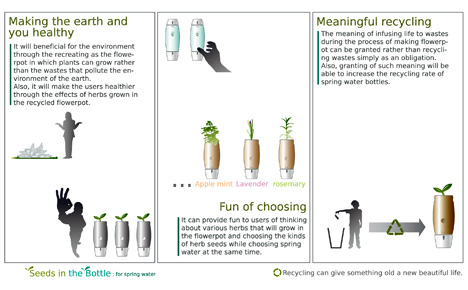
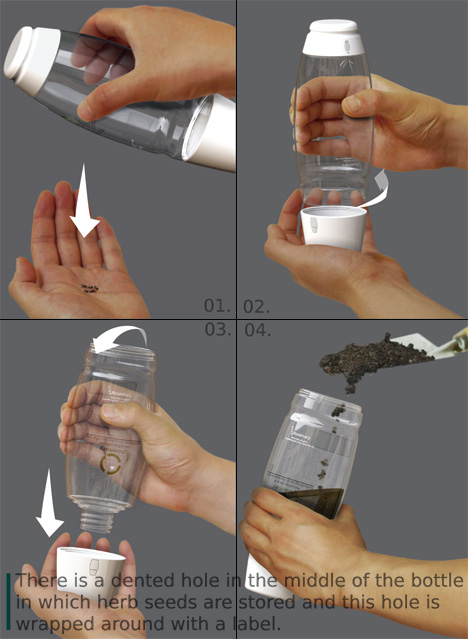
Did you know 77% of the world’s plastic bottles end up in landfills? That amounts to tens of metric tons of waste every year. If recycling isn’t the only answer, maybe we need to think of new ways to extend the lives of these bottles. Seeds in the Bottle is a project by designer Yun Hwan Sung with a little surprise in each package. Tiny herb seeds are stored inside a pocket you release into the bottle when you’re done with it. Invert the bottle, fill with potting mix, water and instead of filling up landfills, you have an herb garden.
Designer: Yun Hwan Sung


WASHINGTON – August is peak water use season and with a few simple tips from EPA's WaterSense program homeowners can save water and as much as $110 annually on their water bills.
“Peak water use can be expensive, taxes local water systems, and threatens future water supply and quality,” said Peter S. Silva, EPA’s assistant administrator for water. “A few simple changes can help consumers reduce their water bills, and in turn, save them money.”
On average, an American household uses about 260 gallons per day, but this amount climbs to around 1,000 gallons per day during peak water use season with some households using as much as 3,000 gallons a day.
Here are some tips to help reduce water use:
* Water yards only when needed.
* Consider using WaterSense labeled toilets, faucets and faucet accessories, which use at least 20 percent less water and can save $60 per year.
* Water landscapes only when needed. Watering in the very early morning or evening is best.
* Wash only full loads of laundry and dishes, and scrape dishes instead of rinsing when loading the dishwasher.
* For a summer refreshment, keep a pitcher of water in the fridge instead of running the tap until it is cold.
* Put your favorite handyperson to work fixing leaks around the home, which can waste about 200 gallons per week. Fixing leaks can add up to about $50 in utility bill savings annually.
In 2008 alone, WaterSense labeled toilets, faucets, and faucet accessories helped Americans save more than 9.3 billion gallons of water and realize more than $55 million in savings on water and sewer bills. That is enough water to supply 100,000 average households for a year.
WaterSense is a partnership program sponsored by EPA to protect the future of our nation’s water supply by promoting and enhancing the market for water-efficient products and services.More tips and information on WaterSense: www.epa.gov/watersense/water/peak.htm Topics: WaterSense
In 2006, California adopted the nation's first comprehensive law to limit emissions of carbon dioxide and other gases that scientists have found to be heating the planet. Last year, state officials laid out a detailed plan of how they plan to slash the state's emissions to 1990 levels in the next 11 years. And they began to adopt regulations, such as the nation's first rule to mandate low-carbon fuel.
But California can't control whether Congress will adopt an effective national climate law and it has no control over whether U.S. action could spur China, India and other fast-growing nations to commit to reducing their carbon footprint at the December negotiations in Copenhagen to draft a climate treaty.
So the nation's most populous state has already begun preparing for the worst: heat-waves, a rising sea level, flooding, wildlife die offs and other expected consequences from what the Intergovernmental Panel on Climate Change, a group of the world's top scientists, predict will be a dramatic temperature increase by the end of this century.
Its called adaptation.
A new comprehensive plan from California's Natural Resources Agency offers strategies to deal with threats in seven sectors from fire-fighting to public health and water conservation. The public is invited to submit comments to the draft over the next 45 days (email address is adaptation@resources.ca.gov.) Public hearings will be held in Sacramento on August 13, and in Los Angeles on a later date.
The draft is "a good step in the right direction," said Gina Solomon of the Natural Resources Defense Council, an advocacy group. "It highlights the importance of local adaptation planning, protecting vulnerable communities and the importance of public education."
But she cautioned: "These are all just words on paper without funding to carry them out. The federal government should help states to prepare for climate change. Spending some money now will save billions later, and these strategies save lives."
David Festa of the Washington-based Environmental Defense Fund, voiced the hope that the report would "add urgency to our state's desperate water supply situation," noting that the Legislature will consider five new water-related bills when it reconvenes on August 17.
ATLANTA (AP) - With drought conditions intensifying across the Southeast, efforts to conserve water are popping up everywhere - even at the aquarium.
In the name of conservation, the Georgia Aquarium, home of the world's largest fish tank, has emptied some of its watery displays. The downtown Atlanta attraction has drained a lake in an atrium, turned off a waterfall and nearly emptied a moat at an exhibit, refilling it with sand.The aquarium isn't alone: A water salute to retiring pilots at the Hartsfield-Jackson International Airport also has been put on hold.The efforts are some of the most unusual as the state contends with one of the worst droughts in its history. Georgia already has banned virtually all outdoor water use and ordered public water utilities to cut back water use by 10 percent.The aquarium also is installing waterless urinals and low-flow faucets, banning pressure-washing of its building and requiring all employees and volunteers to take a water-conservation course.None of the drained exhibits contained fish, aquarium spokeswoman Meghann Gibbons said. Exhibits with fish continue to operate normally, she said."We've tried to do anything we can internally," said Gibbons. She estimated that changes at the aquarium will save more than 3 million gallons a year.Along with saving water, the measures have had a financial bonus: Pennies that visitors toss into a pool once brimming with water are now easily accessible. "And they've been turned in to the bank," Gibbons quipped.On a smaller plumbing scale, operators of a northeast Georgia dental clinic installed two portable toilets in the parking lot last week to cut down water usage by their staff members."People are flushing the toilets pretty regular when you have 30 employees and six or seven doctors," said Bob Fogg, who operates Athens Family Dental Center with his wife and sister-in-law.The dentists' patients still get to use the center's regular toilets.The airport has banned its "washdown" salute given to retiring commercial airline pilots on their final flight to the airport. For decades, two Atlanta Fire Department trucks would spray an arch of water to salute the pilot.
However, that display used about 500 gallons of water."We're trying to mainly use water for essential firefighting operations," said Capt. Bill May, a fire department spokesman. "Maybe if we can get the water supplies back up, we can revisit the process."The drought has worsened with sweltering temperatures and a drier-than-normal hurricane season. Now drought in almost one-third of the Southeast has been deemed "exceptional" - the most severe drought category.West Georgia's Paulding County has taken some of the most aggressive steps so far, restricting watering for landscapers and car washes that don't recycle and imposing fines on first offenses for watering violations. The county has also ordered homes and business to cut water use by 10 percent or face stiffer fees."I feel like we're staring ugly in the face," said Jerry Shearin, Paulding County's commission chairman. "It's a very critical situation. And we're going to prove to the world we're doing everything we can to conserve."
The City of Corpus Christi Water Department is pleased to report that students, teachers and students' parents at Jones, Oak Park, Prescott, Sanders and Travis Elementary schools have made a significant contribution to the community through their participation in the City's free Learning to be WaterWise educational program. In fact, officials say that during the 2008-2009 school year, the program resulted in an estimated savings of 5,186,537 gallons of water.
Learning to be WaterWise is designed to help educate participants about the importance of water and energy efficiency. As part of the effort, teachers and students in the selected schools received classroom booklets and water saving activity kits containing high efficiency plumbing devices. With the help of their parents, the students installed the items in their homes and conducted a home survey that measured the water, energy and money that was saved as a result of the materials. According to Belinda Ramirez, who is a teacher at Prescott Elementary, the program helped foster "enthusiasm and new awareness for water conservation" among the students who participated in the activities.
The WaterWise program was funded through the City of Corpus Christi Water Department's Public Education and Communications Activity. For more information, please visit www.corpuschristiwater.com.
Stage II water restrictions aren't fun, but they are a necessary tool for drought management.
And if the restrictions have put the region's crucial water supply issue on your radar screen, it is a good time to consider long-term conservation measures.
The San Antonio Water System is a national leader in conservation measures, and the utility's long-term programs, including some that feature rebates, remain under way during this drought-management period.
“Our customers are participating in record numbers in conservation management,” said Karen Guz, SAWS conservation director.
The conservation programs include a landscape rebate of as much as $525 for using new low-water plants and as many as two free water-efficient toilets if you have water-wasting toilets and your house was built prior to 1992.
Others include a $100 rebate for purchasing a water- and energy-efficient washing machine and a $150 rebate for a system that provides hot water on demand and avoids wasting water while waiting for it to get hot.
Full details on eligibility requirements and other specifics of these programs are available online at www.saws.org, or you can call 704-SAVE.
Additionally, Guz said SAWS officials are preparing some drought-recovery programs for the fall that will be unveiled later this month. Those programs likely will include a rebate and free mulch delivery for residents who are reducing the amount of grass in their lawns.
Check the SAWS Web site for details toward the end of the month.
The utility's conservation programs are a winning proposition for ratepayers. Bills will decrease along with the amount of water being used, and reduced pressure on officials to find new water supplies will also help control water costs.
photo: J. NovakMany western states, like California, recently have had to contend with some severe water issues, so how has Phoenix, which is located smack in the middle of the desert, managed continually to serve the water needs of nearly 3.5 million people? The answer is a lesson in how a comprehensive water strategy can effectively serve an area not blessed with an overabundance of water, and how these ideas can be utilized throughout the country.
Fresh water seemingly should be a point of contention in a city like Phoenix, but some how this city in the midst of a vast desert still manages to serve its residents' water needs, according to a story on Mother Nature Network.
Water Conservation Efforts Make a Difference in Phoenix
Conservation ideas set forth by the city’s Water Resource Plan reduced the city’s water use by 20 percent. The plan, which emphasizes everything from xeriscaping to doing laundry at night and flushing the toilet only when necessary, proves that these techniques truly can make a difference. According to the mayor, that’s why the city is so far ahead of the game.Mayor Phil Gordon says that Phoenix uses less water today than they did a decade ago, and less per capita than two decades ago, which was well before the city's recent population explosion. First, the city had to find a reliable source of water and get that water to the city's residents. A network of canals in and around Phoenix send precious untreated water from the Salt River Dam, where turbines generate electricity for much of Arizona, to various water treatment facilities around the city. "Using nothing more than gravity, city controllers can open up smaller networks of canals on a regularly scheduled basis for landscaping use," according to the city of Phoenix Water Resource Plan.
The city is also planning for future shortages by banking on aquifers. These basins can hold a great lake's worth of water which can be banked over the years whenever Arizona has excess. The city's Department of Water Resources focuses on reuse and conservation to maximize the amount banked each year. The stored water, which amounts to more than a year's supply for emergency use, is scrubbed clean by minerals, according to Jack Lavelle of the Arizona Department of Water Resources.
With Drought a concern across much of the country, it's smart to practice water conservation. Here's how:
Install a drip irrigation system -- a network of plastic pipes to carry a low flow of water to plants -- around trees, shrubs, flowers and veggie gardens. Drip irrigation systems can use up to 50% less water than sprinklers, and they deliver water more slowly and directly to plant roots.
Design the landscape carefully. Group together plants with the same needs. Put plants that require the most water closest to the house; those that need less water should be on the edge of your property. Also, be sure to select plants that are native and drought resistant.
Use a rain gauge to track how much rain your property gets.
Collect rainwater. It's free and quite easy to do. Rain barrels efficiently collect rain from your home's downspouts.
Water early in the morning or late at night and when the winds are calm to minimize evaporation.
Mulch to retain water and reduce weeds.
Sometimes the best way to get people fired up about a cause—be it environmental, political, or anything else—is to get them angry. But instead of trying to piss citizens off, a Brazilian environmental group is trying to get the country’s residents to, well, urinate in the shower.
The group says that if a single household flushed the toilet just one fewer times a day, it would save a whopping 1,157 gallons of water each year. The organization has even come out with a video touting the idea. Urine is sterile, so peeing in the shower is harmless (except if someone has a disease that can be transmitted through their pee, such as hepatitis).
The AP reports:
The spot features cartoon drawings of people from all walks of life - a trapeze artist, a basketball player, even an alien - urinating in the shower.
Narrated by children’s voices, the ad ends with: “Pee in the shower! Save the Atlantic rainforest!”
Watch it here:
On the way into Sumner via Traffic Avenue, just next to the city sign, sits a small sandwich board with big block letters: “Please Conserve Water.”
It’s just one of the ways city employees are urging residents to cut back on their water use during August, which is typically the year’s driest month.
“We’re looking ahead and we’re not seeing much rain in the forecast,” Sumner Communications Director Carmen Palmer said. “If we’re not careful now, it could be a problem.”
During the period of hot weather — the high temperatures have been more than 20 degrees warmer than average in the past several weeks — the city is having difficulties maintaining much-needed water in city reservoirs. The situation isn’t dire, Palmer said, and there are still about 2.3 million gallons of water in just one of the reservoirs. Still, with limited rainfall in July and similar predictions for August, the resevoirs aren’t filling back up at night like they do in winter. It could be a cause for concern, especially if there is a fire in the area that would need much of the city’s water to extinguish.
“Sumner has lots of water (for now), but if we’re in this for the long term, we may not,” she said. “We’re asking people to develop slightly more conservative habits.”
What the city wants to stress, Palmer said, is that conservation is totally voluntary for residents. To set good examples, city employees themselves have been choosing to use water wisely, both on the job and in their personal lives.
Maintenance workers are cutting back on watering at city parks and the Sumner City Cemetery.
“Those are (the city’s) big uses of water,” Palmer said.
She has tried to cut back on water use at home, too.
“I was washing lettuce for dinner and instead of just draining out the sinkful of water, I used it to water my plants with a cup,” Palmer said. “We’re really not asking citizens to do anything we’re not doing.”
-------------------------------------------------------------------------------------------------------------
Ways to Not Waste Water Some water-conservation tips from the city of Sumner: Water gardens every other day. A simple trick that Sumner Communications Director Carmen Palmer suggests: Houses with even-number addresses water on even-number days and those with odd-number addresses water on odd-numbered days.
Water gardens in the early morning or late at night — the cooler air means less of the water evaporates into the air and more gets right to the plants.
Avoid non-critical uses of water, like car washing. “We’re asking people to hold off washing things, like cars, that aren’t totally necessary,” Palmer said.
Put pitchers of water in the fridge for cold drinking water, instead of letting the faucet run until cooler water appears.
Find ways to double the uses of water, like watering plants with sinkwater after rising vegetables.
Shorten shower times. Shorter showers use less water than baths.
Fix any pipe leaks immediately. If it’s necessary to shut off water at the meter, call the city at 253-299-5740 instead of trying to do it yourself, which often causes breakage and “gushes.”
More water conservation tips can be found online at www.wateruseitwisely.com and www.awwa.org.
Urban water use in San Diego County has decreased by 9 percent during the past six months, according to a recent report by the San Diego County Water Authority.SDCWA attributes the drop to cooler weather during that period and conservation by residents and businesses.Water use between January 2009 and June 2009 was down 9 percent when compared to the same six-month period in 2008.Preliminary data also showed accelerated conservation in June. During that month, consumption fell by 24 percent compared with the previous year. SDCWA contributes the drop to unseasonably cool weather and aggressive public education campaigns encouraging conservation.“The community is pulling together and making a big difference in saving water, but our true tests still lie ahead,” said Claude “Bud” Lewis, chair of the water authority board. “For example, we need to continue to save as much water as we can through the summer months when water demand is highest.”The decline is an encouraging sign to county water agencies, having occurred one month before SDCWA declared a Level 2 “Drought Alert,” imposing mandatory reductions in water consumption.In March, the Metropolitan Water District of Southern California cut water deliveries to the San Diego region by 13 percent. The cut was ordered in response to a supply shortage generated by regulatory restrictions on water deliveries from the Bay Delta region and prolonged drought conditions.SDCWA’s drought restrictions have enabled its member agencies to restrict outdoor watering to three days per week.SDCWA will continue to closely monitor water use and deliveries to its member agencies to keep the region on track to meet its conservation goal.Lewis hopes conservation will become not just a short-term change, but a permanent way of life for area residents.“We need to make saving water part of our lifestyle to help us cope with multi-year supply challenges posed by regulatory restrictions on water deliveries and the potential for lingering drought conditions,” Lewis said.
New guidelines for implementing water restrictions were approved by the Rockport City Council at its regular meeting July 28. The action amends the City Water Conservation Plan to mirror that of the City of Corpus Christi’s Water Conservation and Drought Contingency Plan which was updated in April.Under previous plans, restrictions were ratcheted up as the combined water levels of the Lake Corpus Christi and Choke Canyon Reservoir System dropped below 50 percent, 40 percent, 30 percent, 20 percent, and 10 percent.Under the new plan, increasingly harsher restrictions are implemented at the 50, 40 and 30 percent levels. The restrictions included in the 20 and 10 percent levels in the old plan are now included in the 30 percent level.Restrictions
When the reservoir storage capacity goes below 50 percent, the City of Corpus Christi will issue public notice informing water users of voluntary conservation measures, and drought management measures which will be taken at 40 percent and 30 percent of capacity.When reservoir capacity goes below 40 percent, vegetation may not be watered between the hours of 10 a.m. and 6 p.m., with certain exceptions.When reservoir storage capacity goes below 30 percent, in addition to the restrictions at the 40 percent level, lawns may not be watered more often than every five days, with certain exceptions.Other changes were cosmetic in nature.City Manager Tom Blazek noted the city ultimately receives its water from Corpus Christi and must therefore abide by its rules, at a minimum. He said the reservoir system fell below the 30 percent level in 2001, and below 20 percent in 1995.
Water reliability is being hotly debated as the state of California is attempting to balance environmental, agricultural and urban demands of one of our most precious resources. Increasing the reliability and meeting the federal environmental mitigation requirements have resulted in substantially increasing costs for delivery of water throughout the state.
The need for balance of the supplies, along with the ongoing drought conditions, has raised awareness within the community that efficient water use not only reduces demand for water but helps the environment and can save you money.
The Santa Margarita Water District recently updated its Comprehensive Water Conservation Program to meet the ongoing challenges. The program encourages long-term conservation by establishing water management standards and provides specific steps to be implemented based on available water supplies.
We are asking our customers to use 10 percent less water. The average single family customer, based on four people, uses 400 gallons per day inside and outside (more in the summer, less in the winter). We are asking you to save 40 gallons per day on average by implementing progressive water practices into your everyday routine:
•Water your lawn, landscape or other vegetated area before 8 a.m. and after 6 p.m. three times per week. Watering three days instead of four can meet the 10 percent reduction.
•Make sure your irrigation or sprinklers operate so water does not runoff onto the sidewalk, driveway or street.
•Use a broom and a bucket instead of washing down sidewalks, walkways, driveways, or patios with a running house. A hose running can use up to 13 gallons per minute.
•Fix any leaks in your house or to sprinklers. A dripping faucet can use 10 gallons per day.
•Go to a commercial car wash or use a bucket or a hose equipped with a self-closing water shut-off nozzle — don't let the water run down the drain.
Reducing your water consumption can save you money. Saving only 40 gallons per day can save you approximately $40 per year. Careful water management is both environmentally and economically rewarding – water users can save money by adopting efficient water use habits.
SMWD water users will continue to see and hear more about our Comprehensive Water Conservation Program as the district increases efforts to further educate customers about water conservation through an updated public awareness campaign – Operation Conservation. For more information about water saving tips, also visit www.smwd.com.
I have spent this week visiting with some of the winners of the Ohio Conservation Farm Family Award. All five of the winners for 2009 will be announced Friday Aug. 7. They will be recognized at the Ohio Farm Science Review on Thursday Sept. 24.
It is humbling to see how much conservation work folks can get done with the help of their Soil and Water Conservation Districts and the Natural Resources Conservation Services. Yes the total accomplishments represent years of commitment – sometimes the sum of several generations dedication as in a tree planting or a contour strip establishment.
Yet time and again when I ask what the secret is, I am told, “We try to do one project a year.” Whether it’s a water way or a wind block, adding drainage, creating a wetland, managing manure, trying a cover crop or killing grape vines, these families make a decision for improvement and keep after it.
It sounds pretty straight forward, but of course it takes a plan and it takes team work with the supporting agencies. It usually involves some cost share support – especially with the options available through Environmental Quality Incentive Program and other options that have been offered through NRCS or the Farm Service Agency. However, there are plenty of projects that get carried out by determined landowners that go forward with or without government help.
It is not unusual that the time required for a project to return its investment exceeds the working life of the farmer who has undertaken the work. Many times a landowner has taken on work that improves the land; its productivity and its value – even though they have no intention of cashing any of that in during their lifetime.
There are no shortages of things we can do maintain and secure our natural resources. Stewardship is duty that rewards conservation practitioners with the promise of future productivity.
It’s worth going after -- one project a year.