SAVING water has become a habit for Sydneysiders, with only a slight increase in water use recorded since drought restrictions were relaxed three months ago.
Water Minister Phillip Costa said use had risen by only 1.3 per cent since the tough five-year clampdown ended in June.
The old restrictions allowed limited, hand-held garden watering and banned the hosing of hard surfaces. The new rules allow hand-held hoses (with a trigger nozzle), sprinklers and watering systems to be used any day before 10am and after 4pm. The ban on hosing hard surfaces, except for health and safety reasons, is still in force.
Businesses such as nurseries and landscaping companies are automatically exempt.
''It's very encouraging to see how well Sydneysiders have learned the tough lessons of the drought,'' Mr Costa said. ''The community have shown a terrific understanding of how precious our water is, and the days of wasting water are behind us. [People] have proved they are using common sense when it comes to this valuable resource and I am confident they will maintain this sensible approach as we move into summer.
''It seems five years of tough restrictions have really led to a change in behaviour, which is a very positive result for our environment. Despite having one of the warmest winters on record, greater Sydney continues to conserve water since Water Wise rules replaced drought restrictions.''
Preliminary figures showed Sydney Water customers used 118.6 gigalitres of water in the past three months, up just 1.5 gigalitres from the same period last year. Mr Costa said the total water consumed was similar to the early 1970s, despite a population increase of about 1.3 million.
"The Water Wise rules give people more flexibility to maintain their gardens and manage water around the home, and reinforce the importance of using water responsibly to minimise waste,'' Mr Costa said.
Despite the ban on hosing hard surfaces, people are allowed to hose their homes to clean up after last week's dust storm.
''Dust can cause respiratory problems and health implications for people with asthma and breathing difficulties,'' Mr Costa said.
"No one will be fined for washing down their home, driveway, car or business in the clean-up after the dust storm. However, it's important people continue to use common sense.''
Monday, September 28, 2009
Sydney wises up to saving water

Saturday, September 26, 2009
Wednesday, September 23, 2009
Fairgoers Pledge to Save Nearly 13 Million Gallons of Water per Month
Californians visiting the 2009 State Fairpledged to save nearly 13 million gallons of water per month at home,according to a tally of pledges taken at the "Save Our Water" exhibit atthe fair. The exhibit, a joint effort of the California Department of WaterResources (DWR) and the Association of California Water Agencies (ACWA),drew more than 9,000 visitors over the course of the fair, which ran fromAug. 21 to Sept. 7.
Fairgoers who took the pledge were asked to commit to simple water-savingactions around the house, including taking shorter showers, turning off thetap while brushing their teeth, and washing only full loads of laundry. Thepledges were tallied last week.
"This kind of response shows that Californians understand our state is in awater crisis," said DWR Director Lester Snow. "As we prepare for apotential fourth year of drought, it is critical that Californians getserious about conserving water."
The 4,000-square-foot exhibit featured educational information about thestate's water problems, including interactive games and age-appropriateinformation for children. The exhibit was highlighted at the fair's "SaveOur Water Day" on Sept. 1, and the first 1,000 visitors through the gatesthat day received free water conservation grab-bags with shower timers,water-saving tips and other information.
"It is very gratifying to see the response to our call for conservation atthe State Fair'sSave Our Water exhibit. It shows that the conservation message is gettingthrough," said Timothy Quinn, ACWA's executive director. "Waterconservation is a major priority for local water agencies, and the publicis responding. As we move into the new water year -- which may again be adry one -- it is critical that we continue to help Californians do whatthey can to reduce their water use."
Tuesday, September 22, 2009
Toilets combine water conservation and efficiency., Briggs Industries, Inc.
Briggs Intros Full Line of High Efficiency Toilets
Charleston, SC-Briggs Industries is capitalizing on surprisingly strong demand for its push button-operated Conserver Dual Flush HET with six new models that add style, shapes and functionality to its product line of high efficiency toilets that are pending EPA Water Sense certification, according to Aron Simons, Marketing and Customer Service Manager.The company's Maelstrom series, which provides powerful one-flush performance, now includes HET versions that "force conservation" by using only 1.28 gpf and come in round, elongated and ComfortFit ADA models.Briggs' popular Conserver Dual Flush HET is now offered in round, elongated and ComfortFit styles. They enable users to select either 1.0 or 1.6 gallons per flush (gpf) and achieve an average water savings of 20% compared to typical toilets. Joining the push button Conservers are three more lever operated, models in round, elongated and ComfortFit ADA designsOffering more than a dozen models and styles of High Efficiency Toilets and Urinals this year, Briggs Industries has deepened its commitment to water and energy-saving products that meet the demanding EPA Water Sense standards.Briggs high-efficiency toilets are constructed from vitreous china and have 2" glazed trapways for more efficient waste removal as well as quieter flush and refill than pressure-assisted toilets. Soon to be released are high efficiency urinals (HEUs) that will reduce water consumption by 50%. The Lawton and Hilton models use just ½ gallon per flush to achieve this reduction.Briggs Industries, Inc. is a subsidiary of CISA, global producer of plumbing fixtures and sanitaryware. It has North American headquarters in Charleston, SC, manufactures in Knoxville, TN and throughout South America. Briggs markets toilet, bidets, urinals, pedestal and vessel lavatories, bathtubs and kitchen sinks. Customers include wholesale and retail distributors, residential and commercial builders, plumbers, and hotel and motel operators. For information, visit www.TheConserver.com
Friday, September 18, 2009
World Water Monitoring Day

Celebrate with us on September 18, or host your World Water Monitoring Day anytime from March 22 until December 31!On
Thursday, September 17, 2009
Stanford Faculty use more water than student and county averages
Faculty account for significantly higher water usage than students on campus. (MICHAEL LIU/The Stanford Daily)
Pop quiz: Who uses more potable water, per person, at home — Stanford students in dorms, faculty and staff living on campus, or the average Santa Clara County resident?
New University data say it is faculty, who use an estimated 25 percent more domestic water per capita than the average local resident, and more than four times as much as the average student.
The data are tracked largely by staff in the University’s Department of Sustainability and Energy Management, who have spent at least $2 million since 2001 encouraging faculty and students to conserve water and use high-efficiency appliances at home.
The department’s 2008 numbers, their most recent, illustrate the contrast: Of the 2.3 million gallons of potable water Stanford used every day last year, about 22 percent was used by an estimated 2,441 faculty and staff members and their families living on campus -about 215 gallons per person per day. An estimated 11,500 undergraduate and graduate students accounted for about 25 percent of the water used, or some 50 gallons per day per student.
According to the U.S. Geological Survey, the average Santa Clara County resident used about 172 gallons, both indoor and outdoor, per day last year.
Pressure to Conserve
These days, however, the University is under water pressure.
It began with the San Francisco Public Utilities Commission (SFPUC), which sells drinking water to Stanford, Laporte said. Years ago, Stanford contracted with SFPUC to receive about three million gallons per day, anticipating the school would eventually need that much.In 2000, the county-issued General Use Permit, which governs how Stanford may develop its land, stipulated that the University not exceed the original three million-gallon allocation. SFPUC has chimed in, too, saying that none of its purchasing agencies, including Stanford, could have more water until at least 2018.
In response, Laporte said, the University developed a water conservation “master plan” in 2000 in hopes of “[reducing] our water use as much as possible so that we can stretch our water supply,” she said.
Shortly afterward, conservation money was budgeted – some $5 million total, of which the water utilities staff has spent about $2 million to date, Laporte said. Another $500,000 has gone to water conservation projects in Student Housing, according to Executive Director Rodger Whitney.
Today, much of that faculty money pays for free “water-wise” house calls for faculty and staff living on campus, as well as recycling old toilets, giving away high-efficiency showerheads and aerators, and helping homeowners replace their lawn with less water-intensive landscaping.
Stanford’s efforts come in the wake of a state-wide water crisis, with Governor Arnold Schwarzenegger officially declaring a drought in June 2008 after more than two years of below-average rainfall. Nearby East Bay Municipal Utility District had also imposed mandatory water rationing the month before the declaration.

Portland named a ‘water wise’ community
American Rivers on Thursday named Portland one of the nation’s top “water wise” communities protecting clean water and public health with innovative green solutions.
Portland was chosen for its response to sewage and stormwater overflows. The report, “Natural Security: how sustainable water strategies are preparing communities for a changing climate,” comes as Congress is gearing up to consider a climate bill including so-called “adaptation measures” that will help communities get ready for the floods, droughts, and waterborne diseases that come with global warming.
“We are at a transformational moment for our nation’s rivers and water infrastructure, and Portland is forging the path to a healthier, more secure future,” said Rebecca Wodder, president of Washington, D.C.-based American Rivers.
In response to stormwater runoff and sewer overflows that have long degraded water quality and threatened public health, Portland integrated a number of green infrastructure solutions with expanded sewer and stormwater pipes. The city’s “green street,” eco-roof, and downspout disconnection programs, while still in early stages, currently capture 15 percent of the city’s annual stormwater runoff and have potential to absorb 80 percent. By 2011, Portland’s investments will reduce sewage overflows by 96 percent. Green infrastructure will provide the added capacity and flexibility to minimize stormwater problems and protect public health, even as extreme storms grow more frequent and intense in a changing climate.
Other water-smart communities include:
• Boston protected wetlands along the Charles River and as a result saves $40 million in flood damage every year.
• Clayton County, Ga., beat the drought with an innovative water recycling system.
• Soldiers Grove, Wis., moved 49 homes and businesses out of the floodplain to higher ground, and now enjoys better protection from floods.
• Staten Island, N.Y. uses streams and wetlands to help transport and treat stormwater runoff.
• Seattle’s embrace of water conservation and efficiency has reduced per capita water use 33 percent since 1990.
• Augusta, Maine, is enjoying improved water quality, healthier fish and wildlife and better recreation, thanks to the 1999 removal of Edwards Dam.
• Grand Junction, Colo., is cleaning up and reclaiming its rivers as social, economic, and recreational amenities.
Monday, September 14, 2009
Apartment Therapy Unplugged | The Nirvana Bathtub
It's the unofficial bathtub of Carl Sagan and star loving bathers everywhere. But instead of bathing under the stars, users get the sense of floating amongst them with the Nirvana bathtub's 360 LED lights...
Thursday, September 10, 2009
Cirque de Soleil Founder Guy Laliberte Travels To Moon For Water Conservation // onedrop.org
Cirque de Soleil founder Guy Laliberte is taking travel to a whole new level.
The animal-free circus creator is heading to the moon – making him Canada’s first “space tourist.” And I really hope the peanuts on board are good, because the 12-day out-of-this-world trip is costing Guy a cool $35 million.
As part of a campaign for his charity One Drop foundation, Laliberte is calling the flight a “Poetic Social Mission, Moving Stars and Earth for Water”, and will present a series of performances in 14 cities in support of water conservation.
Heavy hitters Al Gore, David Suzuki, Shakira and U2 are stated to be involved with the production that will include music, dance, visual arts and photography – all with an environmental theme.
Still not really sure what to make of it? Neither are we. But we’re pretty sure it’s going to be awesome. To learn more about Guy’s organization, visit OneDrop.org.

Tuesday, September 8, 2009
Restaurants conserving water, glass by glass
"Would you like water?" is now a common refrain at restaurants which, in many areas, are required to ask first before serving.
The move to pour only on request is a common step -- albeit small -- toward overall water conservation.
But does it really help?
Story continues below Stan Lim / The Press-EnterprisePatrons Rosemary Chambers, left, and Kathy Weber, both of Riverside, have lunch that includes glasses of water they requested at Crest Cafe in Riverside.
Experts say that for every one glass of water served, it takes about three more glasses of water to wash the glass. So in a restaurant that serves 100 customers a day, if half skip the 8 ounces of water, at least 12½ gallons are saved.
"Is it a lot of water saved? Absolutely not," said Tim Barr, water use efficiency manager for Western Municipal Water District in Riverside. "To us, it's a valuable public relations tool. The customers remember there's a drought on and they should be doing something at home. That's the real value."
Western, which serves parts of Corona, Norco, Temecula, Murrieta and Riverside, doesn't limit restaurant water service until the third stage of its drought response; the district is now in stage 2, which aims for 10 percent conservation and allows outdoor residential irrigation only three days a week.
Last week, the agency distributed free water-on-request displays for tables at restaurants, he said.
Water-on-demand is part of a larger trend among restaurants to conserve water and whittle costs.
Noting that the cost of a gallon of water is rising faster than the rate of inflation, the National Restaurant Association advises its members to cut costs by taking such measures as washing vegetables in a basin instead of under running water and checking for plumbing leaks, spokeswoman Annika Stensson said.
When Corona restaurant owner Agatha Tsirtsis got an e-mail from the city a couple months ago asking for beefed-up conservation, she complied -- starting with glasses of water.
"We posted some laminated notices in the front entrance telling our customers (water) is going to be served on request only," said Tsirtsis, owner of Citrus City Grille.
Story continues below Stan Lim / The Press-EnterpriseThe days are mostly gone when restaurant patrons sat down to a table with water-filled glasses. As a conservation measure, above, Rosa Gossling serves customers at Crest Cafe in Riverside if water is requested.
Now, when the weather is hot, almost all customers opt for water. But when temperatures are cooler, about half of the diners do without, she said.
"We used to put water out there, and a lot of the water was just wasted, so it definitely helps," she said. "We're more conscious of our practices as well."
Tsirtsis and her husband, Steve, told their employees to defrost foods overnight in the refrigerator instead of under running water, and to run only full loads through the dishwasher.
Corona is in the second stage of its drought ordinance, which prohibits restaurants from serving water unless requested. In other cities, including Redlands and Riverside, the move is voluntary.
Over the past two years, Riverside Public Utilities has given out about 51,000 cardboard drink coasters with water-saving tips to about 50 restaurants, said Mike Bacich, the city's sustainability officer.
The Crest Café is one of those eateries. Manager Alfonse Sadek said the restaurant switched to a water-on-demand policy about six months ago after getting the city's promotional items, though he's not sure it's very effective.
About half of the café's 100 customers a day skip the water but order a soft drink in a glass that also must be washed, Sadek said. But running a tray of 40 cups through the dishwasher only takes about 1½ gallons, he said.
One of his customers, who was sipping iced tea at lunch and passed on the water, applauded the effort.
"They just throw it down the drain if you don't drink it. We all need to be conserving," said Mary Johnson, of Riverside.
Thursday, September 3, 2009
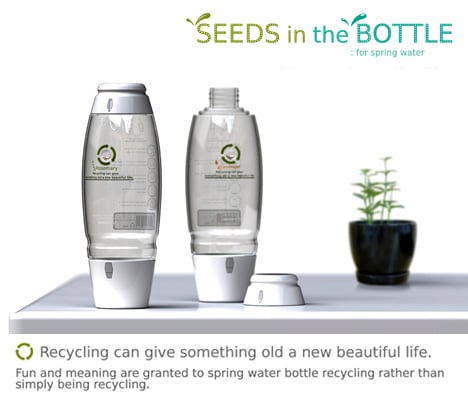
Seeds In The Bottle - Recycled PET Bottle Pots » Yanko Design
Bottling Water With A Surprise
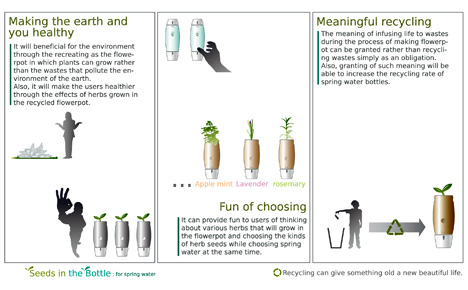
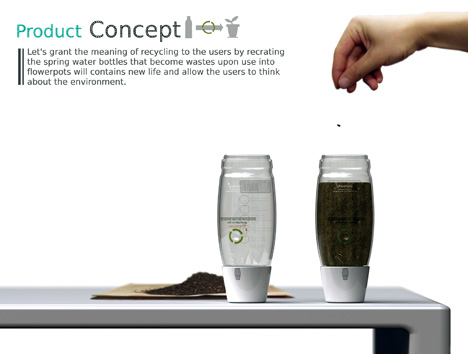
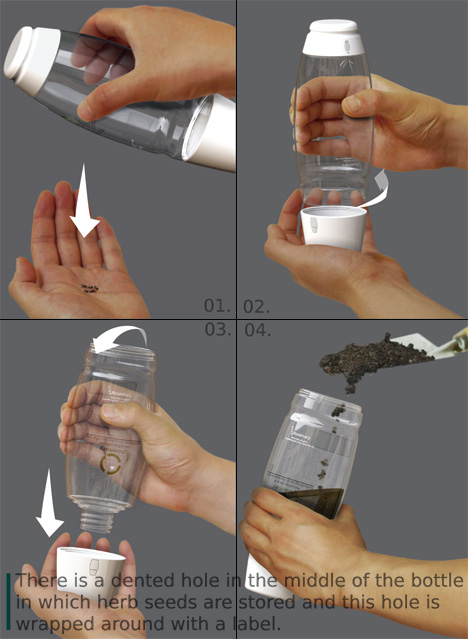
Did you know 77% of the world’s plastic bottles end up in landfills? That amounts to tens of metric tons of waste every year. If recycling isn’t the only answer, maybe we need to think of new ways to extend the lives of these bottles. Seeds in the Bottle is a project by designer Yun Hwan Sung with a little surprise in each package. Tiny herb seeds are stored inside a pocket you release into the bottle when you’re done with it. Invert the bottle, fill with potting mix, water and instead of filling up landfills, you have an herb garden.
Designer: Yun Hwan Sung


Spruce up landscape, water conservation with plants


•
Switch from overhead irrigation to a more efficient drip system.
•
Convert traditional irrigation controllers to smart weather-based controllers that measure precipitation, solar radiation and wind, and adjust systems automatically as needed.
•
Maintain landscapes that are in harmony with the environment by reducing green waste, nurturing healthy soils, creating wildlife habitats and reducing storm water runoff.
•
Analyze water usage trends and develop a water management plan to ensure irrigation systems operate efficiently, irrigation runoff is reduced and reclaimed water is used.
•
Practice hydro-zoning, or grouping plants with similar water requirements on the same irrigation valve to reduce overwatering.
•
Install flowering perennial plants to provide a sustainable and cost-effective replacement for seasonal color changes.
•
Implement a rotation schedule for water features so fewer operate at one time, reducing energy costs.
•
Retrofit the landscape with sustainable, water-efficient landscapes and native, drought-tolerant plant materials to reduce the use of natural resources and decrease the amount of maintenance required.
•
Optimize the placement and health of trees around your buildings to increase shade and reduce energy costs.
•
Maintain the landscape in a natural fashion by using pruning techniques that highlight the individuality of each plant.
•
Explore public programs offered by water districts, cities or other entities that provide rebates or credits for upgrades to smart controllers, efficient irrigation, overhead spray to drip conversions and rain/wind shut-off sensors.